
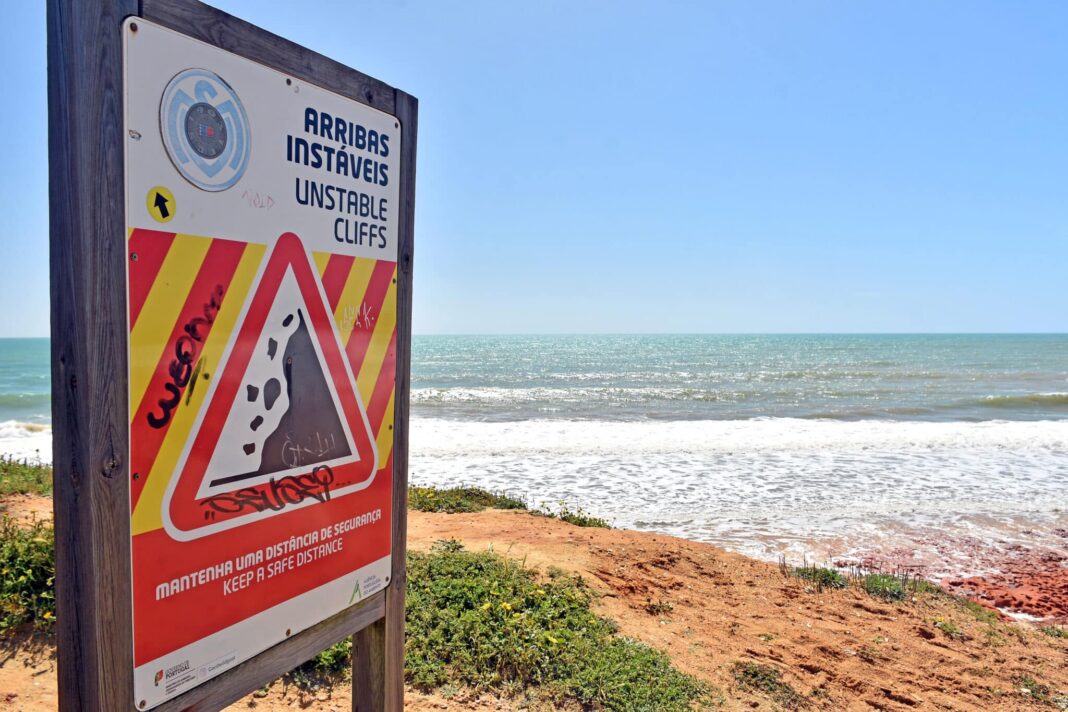

Portugal’s Environment Minister has branded repairs to the Algarve’s storm-battered cliffs “super urgent” following a visit to Albufeira on Tuesday, March 3.
Speaking to reporters, Maria da Graça Carvalho said stabilising the cliffs is a priority for the government to guarantee “the safety of those who visit the beaches.”
Her comments come after pounding rain and strong winds battered mainland Portugal from late January into early February.
The minister toured Maria Luísa beach and Peneco beach in Albufeira to see the damage first-hand, revealing the damage of the storms stretches the length of the country from Moledo in Caminha, in the Viana do Castelo district, to Vila Real de Santo António in the Algarve.
But it is the Algarve that is causing the biggest headache. “There are more problems with the cliffs and the most complicated cases” in the region, she said.
Fears over iconic beach rock
One of the most worrying situations is the state of the iconic rock on Praia do Peneco – a landmark that has become a symbol of Albufeira. Cracks have been found in the rock, and a safety cordon has been put in place to stop people getting too close.
Albufeira mayor Rui Cristina – who has already admitted that the rock may have to be demolished – warned the rock poses risks and “may collapse at any moment.”
“It is something very symbolic, an emblematic rock that represents Albufeira. We will do everything to keep it,” he said.
However, he made clear that any solution would have to come from technical experts at the Portuguese Environment Agency (APA) and the National Civil Engineering Lab (LNEC) “to safeguard it in the best way.”
The minister confirmed she will ask LNEC to “support a decision” on what should be done, stressing that the goal of any intervention is “guaranteeing safety.”
Summer deadline
With the busy bathing season looming, the pressure is on. The Portuguese Environment Agency (APA) is completing a full inspection of the coastline. Its conclusions – along with details of planned projects – will be presented on March 11 in Porto.
Maria da Graça Carvalho said the government’s coastal strategy is split into three strands: urgent cliff safety, sand replenishment to rebuild beaches and longer-term structural works requiring environmental impact studies.
In the short term, the focus is on making beaches ready for summer. That includes stabilising cliffs, carrying out small and medium sand refills and repairing boardwalks.
“The objective is that these works are completed before the start of the bathing season, using fast and flexible funding,” she said.
Bigger projects, involving environmental impact assessments, are not expected to be ready until next year’s bathing season.
“We have to do it and it has to be well done,” the minister insisted, adding that although the Algarve faces the toughest challenges, monitoring by the APA “is continuous and systematic throughout the national territory.”
Reinforcement of sand on some of the country’s “most emblematic beaches” is expected to take place between May and early June.